We often think about supervision in terms of what happens at work. The difficult conversation, the complex case, the decision we’re not quite sure we’ve got right, or the situation that keeps going around in our head long after we’ve gone home.
But supervision isn’t only about what happens in our work. It’s also about what those experiences leave with us.
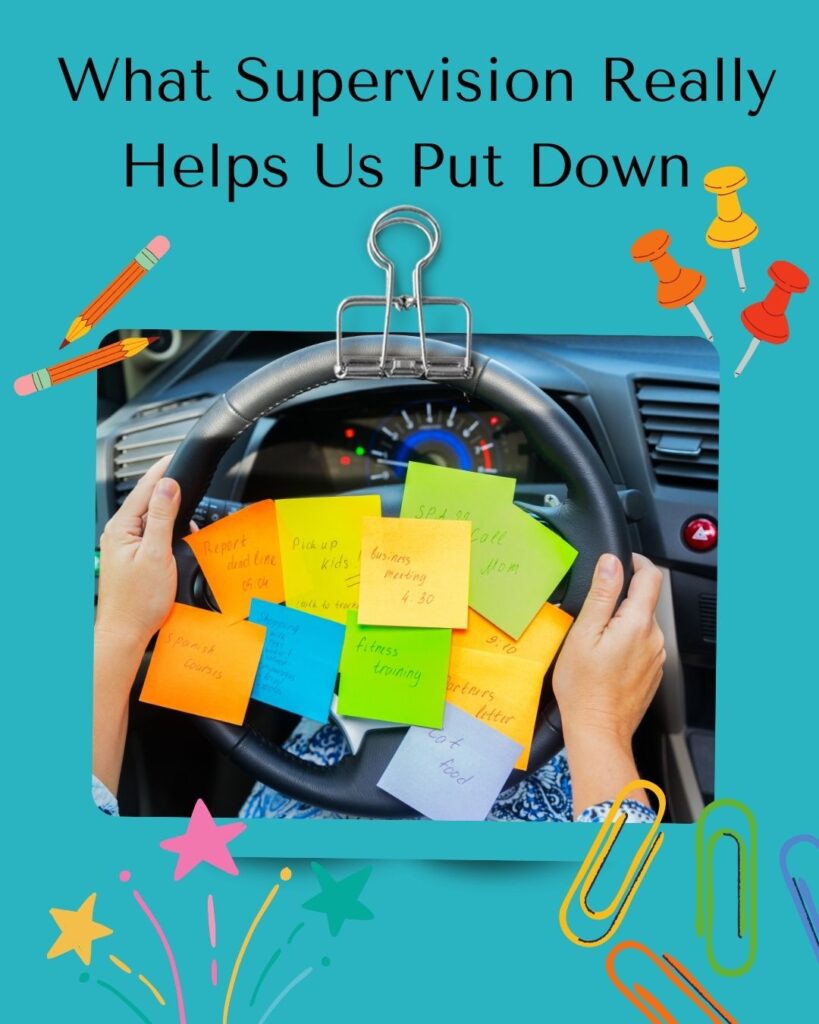
When your role involves supporting other people, it can be surprisingly difficult to leave work completely at work. You might find yourself replaying a conversation on the drive home, wondering whether you could have said something differently. You might feel responsible for someone else’s wellbeing, or find yourself thinking about a young person, colleague, client or family long after the working day has finished.
Sometimes we don’t even realise we’re carrying it until someone asks, “How are you?” and we realise the answer is more complicated than we thought.
This is where good supervision can make such a difference. It gives us somewhere to pause, step back from the immediacy of our work and really think about what’s happening.
What am I noticing? What am I feeling? What am I assuming? What belongs to me, and what belongs to the person I’m supporting?
People who work in education, counselling, mental health, charities and other helping professions often care deeply about the people they support. That’s part of what makes them good at what they do. But caring and carrying are not the same thing.
We can care without taking responsibility for everything. We can be compassionate without absorbing someone else’s distress. We can be committed to our work without allowing every difficult situation to follow us home.
Supervision gives us a safe place to explore the things we don’t always say out loud.
“I’m finding this person difficult.”
“I don’t know what to do next.”
“I’m more affected by this than I expected.”
“I’m worried I’ve got it wrong.”
These aren’t signs of professional failure. They’re opportunities to reflect, learn and gain a different perspective.
Sometimes we simply need to slow down before we decide what to do next. In busy working environments, we’re often focused on action: What needs to happen? Who needs to be contacted? What needs to be resolved?
Supervision gives us permission to pause and ask, “Have I really understood what’s happening here?”
At Livewell, we see supervision as a collaborative and reflective process. It’s not about having someone tell you what to do or having all the answers. It’s about having a professional relationship where you can think out loud, explore different perspectives, be gently challenged and develop your own understanding.
Perhaps one of the most useful questions we can ask ourselves is:
What am I carrying that I haven’t had the opportunity to put down?
It might be a difficult case, a challenging relationship, a conversation, a decision, or simply the accumulated emotional weight of doing work that matters.
Supervision won’t necessarily make those things disappear. But it can help us understand them, put them into perspective and remind us that we don’t have to carry them alone.
At Livewell Counselling Services, we provide professional and clinical supervision for people working in education, mental health, charities and other roles where supporting others is at the heart of what they do.
Because the people who support others deserve somewhere to be supported too.
Sometimes supervision isn’t about finding the answer. Sometimes it’s about having somewhere safe enough to ask the question.